


06 May Make Your Bord Bia Bloom 2026 Stand Impossible to Walk Past
Bloom is back at the Phoenix Park from 28 May to 1 June 2026, and if you’ve exhibited before, you already know the challenge: 100,000+ visitors over five days, hundreds of stands competing for attention, and the cruel reality that most people will walk past yours without breaking stride. The exhibitors who win at Bloom aren’t always the ones with the biggest stands or the flashiest branding. They’re the ones who give visitors a reason to stop — and more importantly, a reason to hand over their details before they leave. Here’s how to do that in 2026.
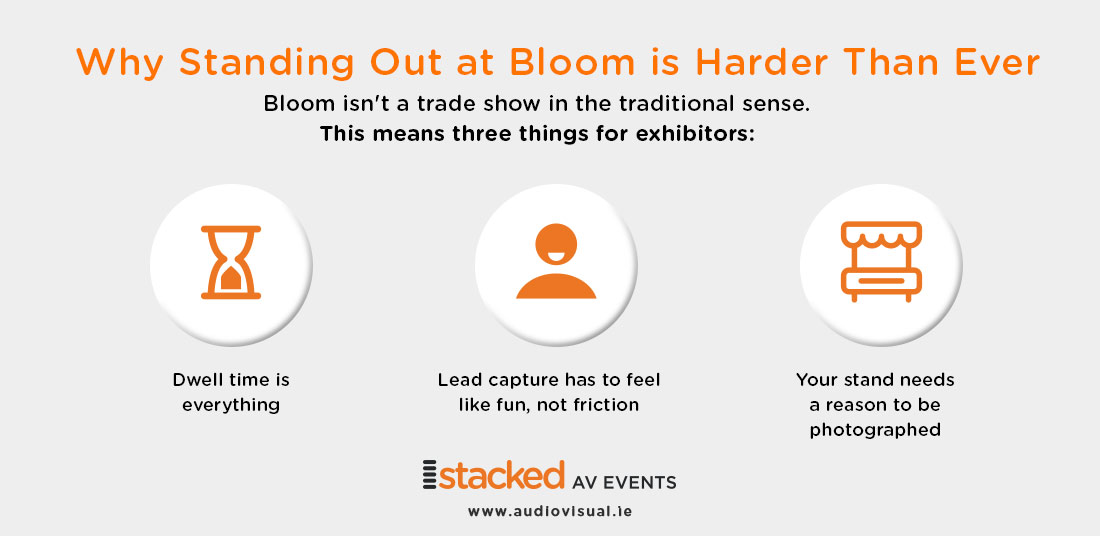
Why Standing Out at Bloom is Harder Than Ever
Bloom isn’t a trade show in the traditional sense. Visitors are there for a day out — they’re walking the gardens, sampling food, drifting between stands with no fixed agenda. That’s a very different headspace to a corporate exhibition where attendees come with a buying checklist. It means three things for exhibitors:
- Dwell time is everything: If you can keep someone at your stand for 60 seconds, you’ve already beaten 80% of your neighbours.
- Lead capture has to feel like fun, not friction: Asking for a business card doesn’t work when nobody brought one. Asking someone to fill out a form on a clipboard works even less.
- Your stand needs a reason to be photographed: Word-of-mouth and social shares drive the back half of the week. If your stand is in someone’s Instagram story, you’ve earned free footfall for free.
Four Tactics That Actually Work at Bloom 2026
1. Build an interactive moment, not a display
Static signage and product samples are the baseline. The exhibitors getting noticed in 2026 are the ones turning their stand into a small experience — a quiz, a spin-to-win, a product matcher, a leaderboard challenge.
A 43″ interactive touchscreen running a custom branded game is becoming the go-to setup for this. We typically specify the iiyama 43″ professional interactive display for this kind of activation — it’s bright enough to perform in the variable daylight conditions you get under a Bloom marquee, the touch response is fast enough for game mechanics to feel snappy rather than sluggish, and it’s built for continuous all-day use across a five-day show without the issues you’d get from a consumer-grade screen.
The setup draws a crowd (people genuinely stop to watch others play), it captures data through the entry mechanic, and it gives visitors a reason to come back later in the day to check the leaderboard. The dwell-time numbers consistently outperform anything passive. The trick is keeping the game simple — under 30 seconds to play, with a clear prize or reveal at the end.
2. Capture leads through the experience, not after it
The biggest mistake we see at Bloom is treating lead capture as a separate step. Visitor plays the game, has a great time, walks away, and you’ve got nothing. Instead, build the data capture into the experience. Email entry to start the game. Phone number to claim the prize. Postcode to enter the prize draw. Done well, this feels like a natural part of the interaction rather than a tax on it — and your conversion rate goes from single digits to 60-70%.
3. Plan your stand for photography, not just visitors
Walk the Bloom show gardens any year and count how many people are taking photos. Now look at the trade stands and count the same. The gap is enormous, and it’s avoidable.
Two things make a stand photogenic: a clear focal point (a screen, a backdrop, an installation, an oversized product), and good lighting. If your stand reads flat in natural daylight — which Phoenix Park has a lot of — visitors won’t bother lifting their phone. LED video walls, illuminated backdrops, and well-positioned spotlights aren’t extravagance. They’re the difference between getting tagged in posts and getting scrolled past.
4. Give people a reason to come back
Bloom runs for five days. Most exhibitors treat each day as a fresh start. Smart exhibitors give visitors a reason to return — a daily prize draw, a leaderboard reset, a “come back tomorrow for X” mechanic. This compounds in a way that’s hard to overstate. A returning visitor brings friends. A leaderboard creates competitive return visits. A daily reveal gives you a reason to post on social each morning.
What This Looks Like in Practice
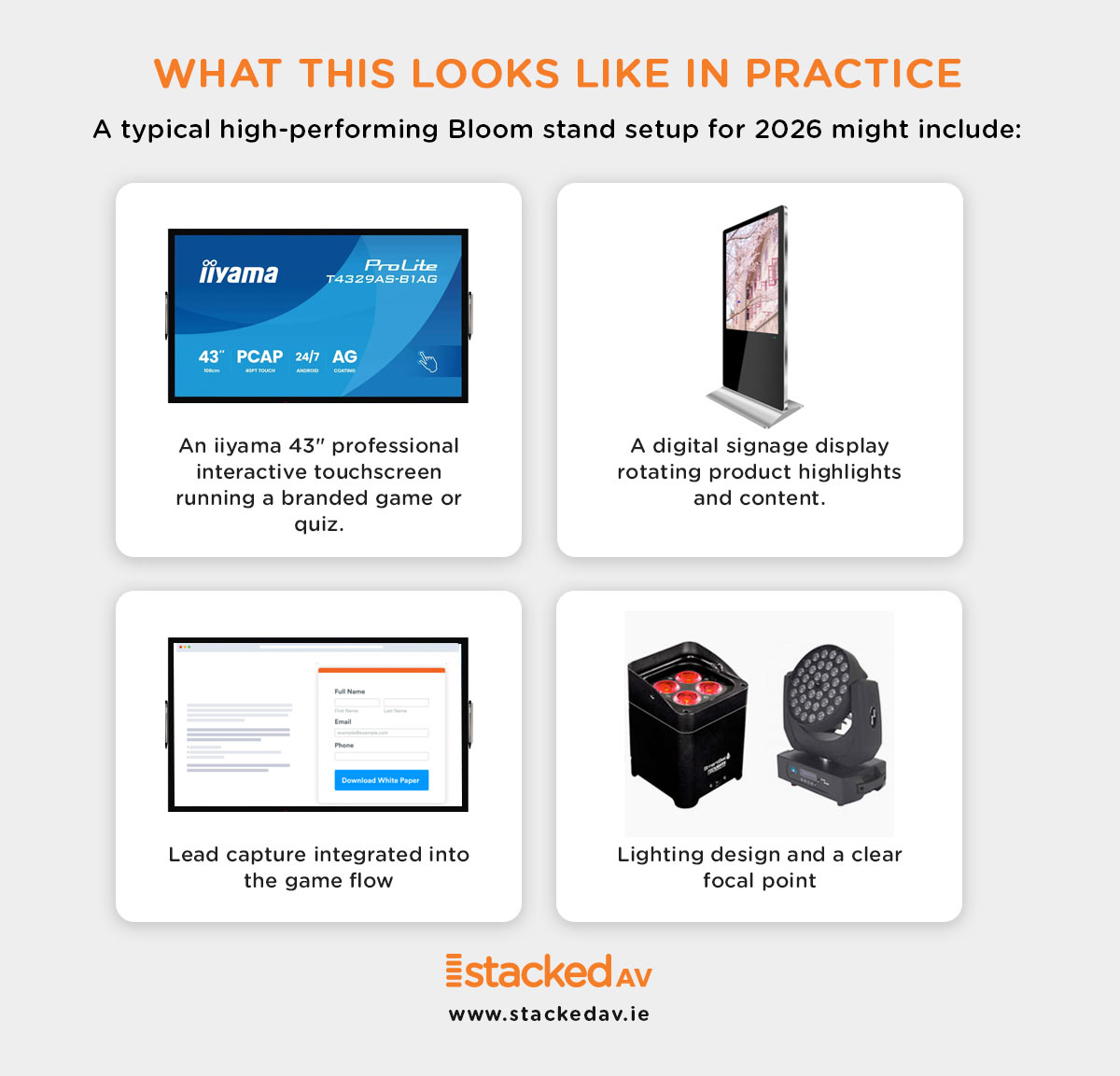
A typical high-performing Bloom stand setup for 2026 might include:
- An iiyama 43″ professional interactive touchscreen running a branded game or quiz, positioned at the front of the stand to draw passing footfall
- A digital signage display rotating product highlights, prize draw entries, and live leaderboard updates
- Lead capture integrated into the game flow, syncing automatically to your CRM or email platform
- Lighting design and a clear focal point so the stand reads well in photos and at distance
AV Suppliers for Exhibitors @ Bloom 2026
We build these setups end-to-end at Stacked AV — hardware, software, branded content, and full setup and breakdown at Phoenix Park. If you’re exhibiting at Bloom 2026 and want to get more out of your stand than last year, get in touch before mid-May. We’re booking up fast for the show, and the lead time on custom interactive content is around two to three weeks.
Bloom 2026: the practical details
- Dates: Thursday 28 May to Monday 1 June 2026
- Location: Phoenix Park, Dublin
- Expected attendance: 100,000+ over five days
- Exhibitor categories: Food & drink, horticulture, sustainability, lifestyle, garden design
Upgrade Your Bloom Exhibit
If you’re exhibiting and want to talk through interactive AV options for your stand — or you’re still deciding whether Bloom is right for you and want to weigh up the ROI — drop us a line. We’ve worked with brands across all the main categories at Bloom and we’ll give you a straight answer on what’s worth doing and what isn’t.
No Comments