



09 Jul What World Cup LED Screens Can Teach Irish Businesses About Display Technology
If you have watched any of the 2026 FIFA World Cup, you will have noticed that the stadiums are competing for attention almost as hard as the teams. In Los Angeles, a double-sided oval screen the size of a small building hangs over the pitch. In Atlanta, a 360-degree ring of LED screens wraps the entire bowl. In Dallas, a centre-hung board stretches from one 20-yard line to the other. The screens have become part of the architecture, and for a lot of viewers they are half the spectacle.
It is easy to file all of that under “things only a billion-dollar stadium can afford.” But the technology behind those screens is the same technology that has quietly moved into offices, receptions, retail units and control rooms across Ireland over the last few years. The stadiums are simply the most dramatic version of a shift that is already reaching ordinary commercial spaces. So it is worth asking the more useful question: what can that World Cup spectacle actually teach a business thinking about its own space?
The Screen Has Become the Building
The most important idea on display at the World Cup is not size. It is the notion that a display should be built into the space rather than hung on the wall of it. A stadium halo board follows the curve of the bowl. A reception feature wall can just as easily be built to the exact dimensions of the wall it sits on, as one continuous image with no bezels, no grid lines and no seams cutting across a logo.
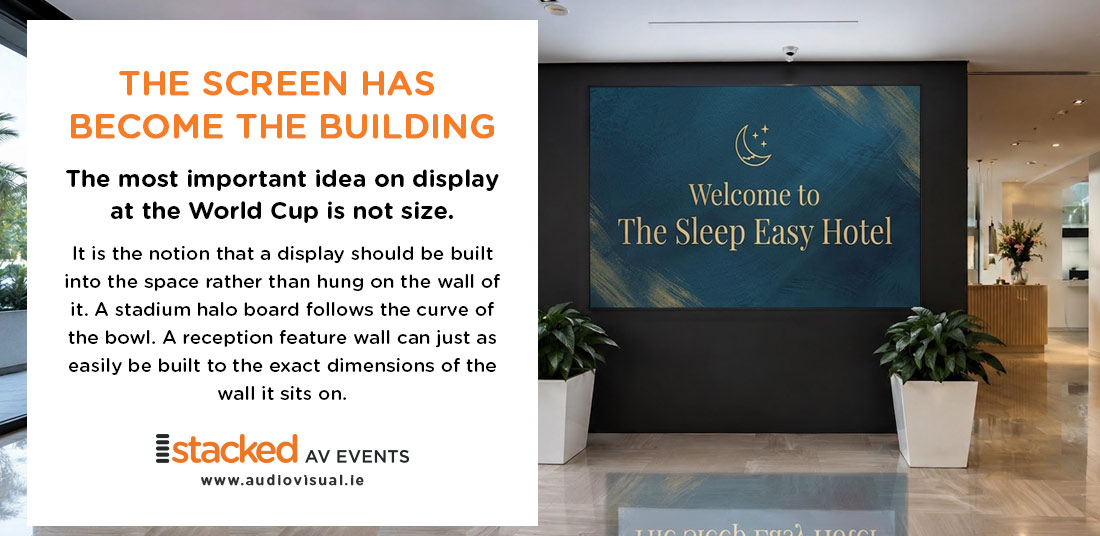
That is the real difference between the direct-view LED technology in these stadiums and the flat-panel screens most people are used to. A traditional video wall made from tiled televisions always has thin black lines where the panels meet. LED video walls are modular tiles that fit together seamlessly, so the picture is genuinely uninterrupted, and the wall can be made almost any size or shape you like. For a client-facing reception, a boardroom backdrop or a large all-hands space, that seamless, made-to-measure quality is exactly what makes a room feel considered rather than kitted out.
Bigger is Not the Goal – the Right Pixel Pitch Is
Here is the single most useful thing the World Cup can teach a buyer, and it is slightly counter-intuitive. A stadium screen and a boardroom screen are built to completely different specifications, and the difference is not really about size. It is about something called pixel pitch.
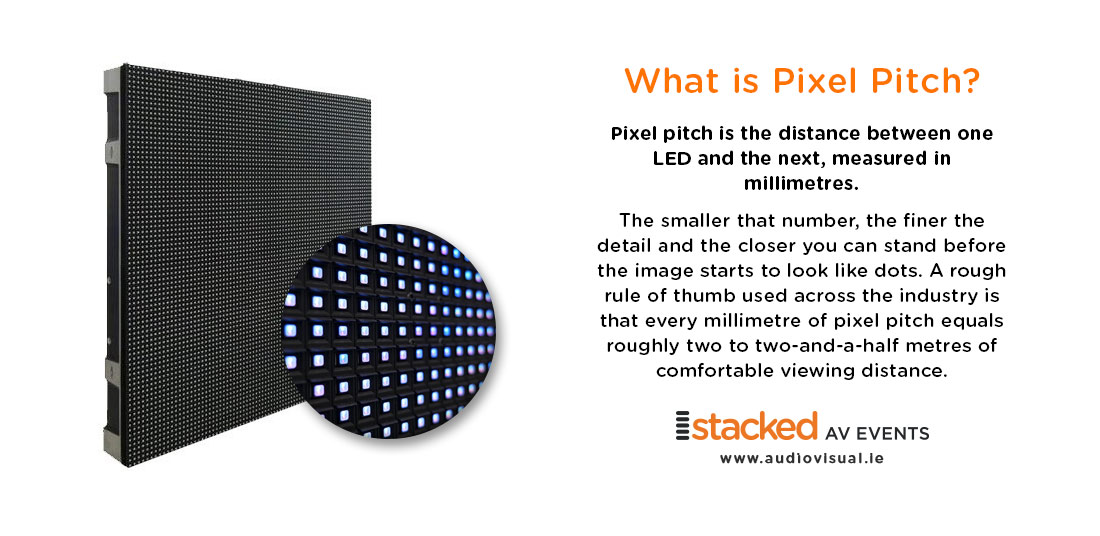
Pixel pitch is the distance between one LED and the next, measured in millimetres. The smaller that number, the finer the detail and the closer you can stand before the image starts to look like dots. A rough rule of thumb used across the industry is that every millimetre of pixel pitch equals roughly two to two-and-a-half metres of comfortable viewing distance. A stadium board might use a relatively coarse pitch because tens of thousands of people are watching it from a long way away. A boardroom wall, where people sit a few metres from the screen, needs a very fine pitch to stay crisp at that distance.
This matters because it is where money is either well spent or wasted. A finer pixel pitch means far more LEDs packed into every square metre, and cost rises steeply as the pitch gets tighter. Halving the pitch can come close to quadrupling the number of LEDs. So the goal is never “the sharpest possible screen.” The goal is the right pitch for how far away people will actually be. Over-specify and you pay for detail nobody can perceive. Under-specify and a wall that looked fine in a showroom looks grainy in your reception. Matching the pitch to the viewing distance is the whole game, and it is the first thing a good integrator will ask you about.
This is no Longer Stadium-only Technology
A few years ago, fine-pitch LED really was reserved for broadcast studios and flagship installations. That has changed. The same class of direct-view LED now turns up in executive boardrooms, corporate lobbies, luxury retail, hospitality and control rooms as a matter of routine. Manufacturers build all-in-one LED walls specifically for meeting rooms, with integrated processing and audio, in slim, wall-mountable cabinets. The stadium is the headline; the boardroom is where the volume of real-world installations actually sits.
For an Irish business, the practical applications are very ordinary and very effective. A seamless wall in reception makes a strong first impression on visitors and can carry brand content, wayfinding, digital signage or a welcome message. A boardroom or town-hall wall makes presentations, pitches and video calls land with far more impact than a mounted television. Operations centres and sales floors use LED walls to keep live dashboards and KPIs visible across a room. And for organisations with several sites, networked walls let one team push consistent content to every location from a single point.
What the Spec Sheet Leaves Out
The last lesson from the World Cup is the one that is easiest to forget in the excitement of a big screen. In Seattle, one of the tournament’s most talked-about venues barely competes on display technology at all. Its reputation is built on crowd noise so loud it has registered on nearby seismographs. The screen matters, but it is the atmosphere around it that people remember.
The business version of that lesson is this: a display is a complete system, not just a panel. The picture on the wall is only as good as the content playing on it, the processing driving it, the sound system alongside it, the mounting and ventilation behind it, and the support keeping it running for years. A beautifully specified wall with nothing thoughtful to show on it, or with no plan for who updates it, underwhelms just as surely as a screen that is the wrong pitch. The cost that matters is not the panel price on day one. It is the total cost of owning, running and maintaining the thing over its life.
The Takeaway for Irish Businesses
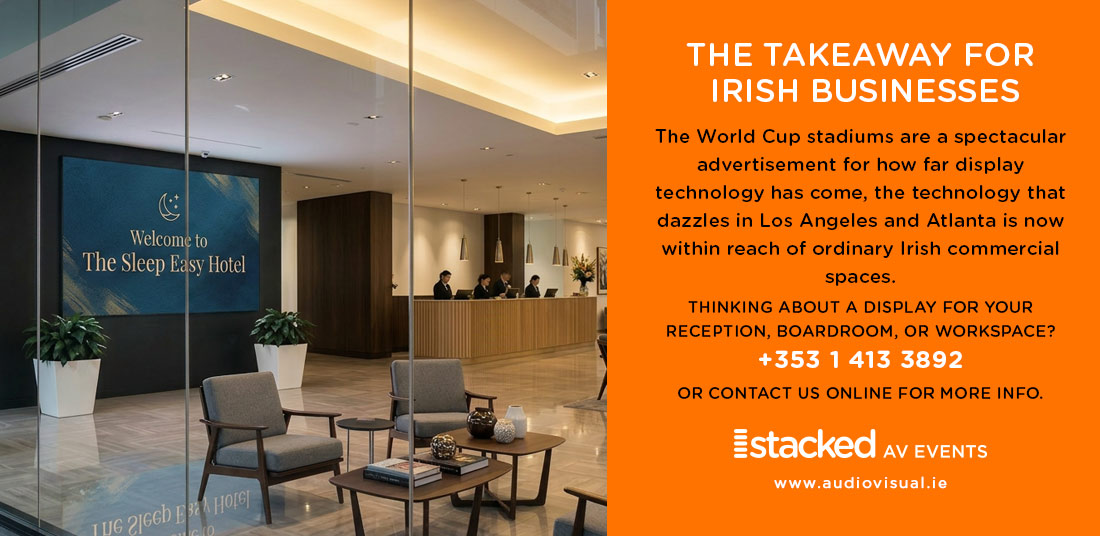
The World Cup stadiums are a spectacular advertisement for how far display technology has come, but the genuinely useful message underneath the spectacle is a calm one. Screens have stopped being an afterthought bolted to a wall and become part of how a space is designed. The technology that dazzles in Los Angeles and Atlanta is now within reach of ordinary Irish commercial spaces, provided the specification is matched sensibly to the room, the viewing distance and the job the screen is actually there to do.
That last part — getting the specification right rather than simply the biggest — is where good advice pays for itself. If you are thinking about what a display could do for your reception, boardroom or wider space, talk to us and we will help you match the technology to the room and the outcome, so the result impresses for the right reasons and keeps doing so long after the novelty of a big screen wears off. Give us a call now on +353 1 413 3892 or contact us online for more info.
No Comments